
Among the qualities that put humans amid the best climbers on the planet is our ability to problem solve. Humans aren’t alone in our ability to solve problems, but we might be alone in our ability to create a problem for the sole purpose of solving it. Bees for example, will fly great distances to pollinate if their local territory is experiencing a drought. That’s an example of problem solving. Bees however would never create drought-like difficulties just to fly further away. When climbing, humans do exactly that. Climbers can easily walk up a path adjacent to a difficult route, but their preference is to create a problem, work really hard, and then celebrate once the “problem” has been solved.
Understanding that humans have this unique gift of reason which allows us to climb better than we otherwise would care to, lead me to consider the gifts of other climbing species. Other species often climb to solve a problem, whether it’s to avoid predators, find food/water, or just go home. Their goals are direct and unfabricated. I began to think about other species of climber in more detail. Of course, there are tree frogs, monkeys, bears, sloths, spiders, mice, opossums, etc., but the coolest climbers of all have to be the Alpine Ibex.
These amazing animals should be the envy of rock-climbing species everywhere, especially their human counterparts, who can only dream of sending walls unaided, without gear, in the alpine wilderness. There are so many interesting facts about the Alpine Ibex, of which, here are five.
5 Things 1 Topic.
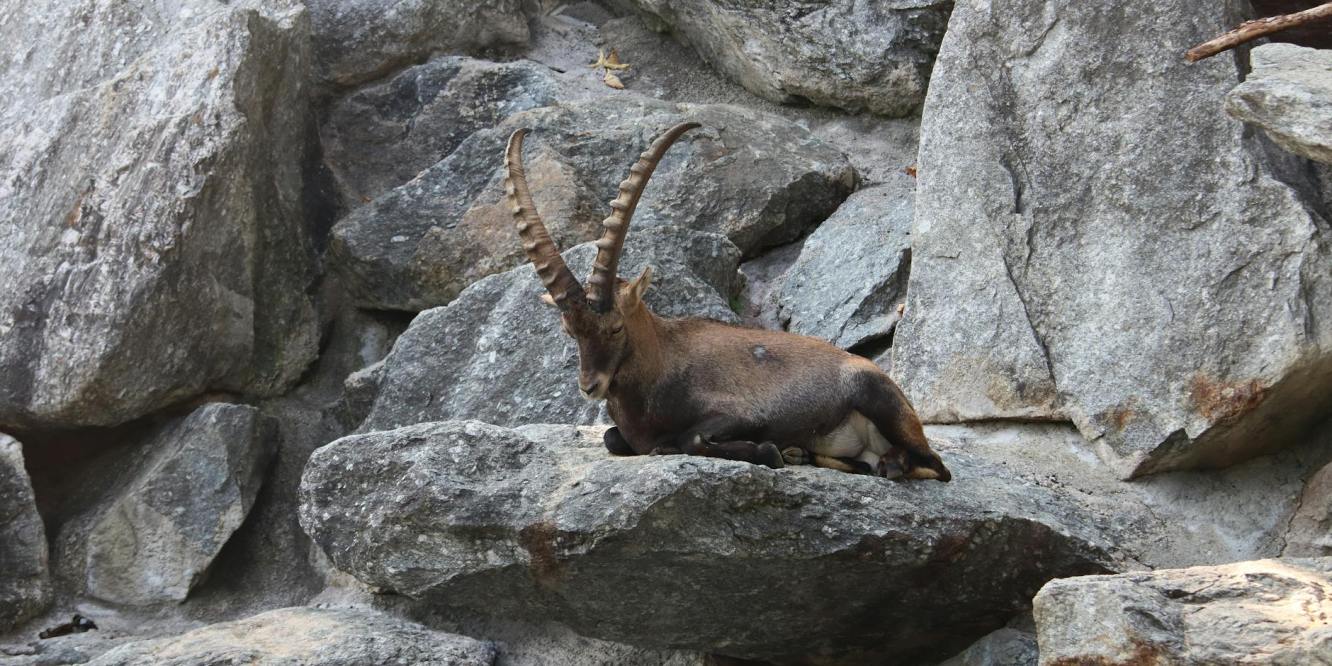
- The Alpine Ibex has horns that can grow up to nearly 5’ long. Like a tree, the age of an ibex can be determined by counting the rings on the horn. Although 5’ horns can look incredibly intimidating, they are generally not used for fighting. What these horns were used for however, is medicine.
- The ibex lived throughout the alpine regions of Europe, from Italy to Germany, with a stable population until the 1600’s. Not only were ibex hunted for their meat, but their horns were said to have medicinal powers. As hunting tools became more advanced (namely guns were introduced) the ibex population suffered dramatic declines. By the 19th century Gran Paradiso, had only around 100 Alpine Ibex left. As conservation efforts grew, so too did the population of the ibex, and by 2005 there were over 4,000 ibex in that same Gran Paradiso area of north-west Italy. Throughout all of Alpine Europe, there are now estimates of thirty to sixty thousand ibex in total. The IUCN now classifies the Alpine Ibex to be an animal of “least concern” because of the stable population and recovery trends.
- While recovery efforts were aided mostly by human awareness and forethought, the ibex did have some ideas of their own. Not necessarily good ideas, but ideas none-the-less. As the population began to dwindle, mating prospects dropped. Luckily for the Alpine Ibex, many domestic goats shared the same habitat. Ibex-goat offspring can survive. However, the long-term outcome of this practice tends to be very low as ibex-goat offspring have incredibly low fertility rates. So, while not optimal, at least the ibex had fun trying!
- The ibex is such a superior climber because of split hoof. If you’ve never seen an ibex climb, check out this video.1 Their hooves have sharp edges with concave undersides that can work somewhat like a suction cup to help them grip small ledges and steep terrain. The split hoof allows them to have supreme balance independent of which side of the leg is weighted. They are also excellent jumpers. The Alpine Ibex can dyno six feet straight up into the air without a running start. With a running start, they are able to jump nearly 70,000 feet into the air! Amazing! That figure might be a little off, since I made it up, but they can jump pretty high! I was thinking it would be funny to create a made-up climbing shoe called “The Ibex” based on the ibex hoof, with a sharp edge, and split sole. Turns out a small climbing company called Saratoga Climbing beat me to it. Here is The Ibex in case you want to take a look.
- Ibex climb rocks because of all the obvious advantages. There is abundant food and water, which non-climbing animals have no chance of attaining. Mountains and cliffs also make for spectacular spots to avoid ground-bound predators. But the reason the Alpine Ibex has achieved real fame in the climbing world is their consistent ascents on vertical dams. The ibex climb these dams for salt! Ibex are salt-aholics, they love it! Not only because it tastes good, but also because the salt deposits provide vitamins and minerals that their bodies require to fuel their “extreme” activities. The more extreme climbs are generally reserved for female and kids, due to their lighter weights, and it is amazing to watch these crushers shred. I don’t usually write about or glorify free-soloing, but if you are an ibex, then by all means climb-on! IBEX!!!
There are so many interesting facts about climbing animals, including the cute and cuddly ibex…these are just five.
V5 5 Things 1 Topic.

- In case you didn’t watch the video above, it’s so sweet. There is a kid ibex following it’s mother to lick some rock nearly 40 meters above the ground. So HERE is another chance to check it out!

 thedihedral.com
So many thoughts and comments here on your very cool entry are in my head. The main thing is that animals try to keep natural order and humans do their best to destroy it.
I don’t know if you read it, but in “Centennial,” which was published the year that I was born, there are many references to animals and nature and how they try to adapt.
LikeLiked by 1 person
The balance is really a thing of beauty…and you’re right we come along and do a great job of messing it all up! I’ll check out the book, thank you for the recommendation!
LikeLiked by 1 person
I’d never quite thought of it that way – that we create problems just to solve them. And here I thought we created problems because we didn’t have the foresight to realize we were creating problems.
I shared a tunnel in South Dakota with the local mountain goats who were licking the walls for salt. While I probably could have used the salts as well, I carried my own.
LikeLiked by 1 person
Haha…the image of you licking a salt deposit in South Dakota with a bunch of mountain goats is too funny. You could be the Jane Goodall of goats!
LikeLiked by 1 person
That video is nerve-wracking and wonderful
LikeLiked by 1 person
I should have put a warning on there about that, but this comment can serve as the missing warning. I was so happy when the baby made it back to the ground!
LikeLike
lol cute and cuddly….we have an issue anywhere near Jasper here…tourists trying to get close enough to elk to hug, never turns out well lol
LikeLiked by 1 person
Yikes, I used to think people were so dumb, and still kind of think that, but perhaps a better way of looking at it is to say that people are so out of touch with nature, that they have no experience or idea that we humans aren’t the center of the world. Rangers have a tall task of educating individuals!
LikeLiked by 1 person
Have you read George Schaller’s book “Stones of Silence”? It’s a long hymn of praise for goats everywhere. “At least they had fun trying.” Thank you for that!
LikeLiked by 1 person
I never heard of it, but I’m adding it to the list!
Total side bar, but the book that I’ve been thinking about more than normal lately is Hunger by Knut Hamson. I’m not sure if that book gets the recognition it deserves, but I haven’t read it in years, and little tidbits of that story pop into my head on a regular basis. As a Lit Professor, is that a book that you explored or put on students radar?
LikeLiked by 1 person
I learned of Hamsun from Hemingway. Thankfully, I only taught literature twice — both summer survey classes so the curriculum was kind of “these are the genres, here’s some stuff you’ll relate to, here’s Odysseus meeting Polyphemus as Homer wrote it and here’s a dumb movie version and anyone who brings me Grendl’s claw doesn’t have to take the quiz.” It was a LOT of fun but Hamsun was way way way too off the main grid for my classes. I don’t have much experience teaching material or subject matter; I mostly taught skills.
LikeLiked by 1 person
Haha…that is really sad, and entertaining! What a great description of a locked in curriculum!
LikeLike
A thoughtful post on another way in which humans manage to unnecessarily complicate our lives. Well, why not? Makes things entertaining! Like watching that video. How bout we solve their problem and just put a big salt lick somewhere they won’t have to climb for it? Aww, then we’d spoil their fun, I suppose.
LikeLiked by 1 person
That is a great solution!!! But I guess you’re right in the end, where is the fun in that!
LikeLiked by 1 person
I look forward to reading your blog and you never disappoint.The video is nerve-wracking and wonderful.
LikeLiked by 1 person
That is so nice, I cannot thank you enough for that!!!
LikeLike