
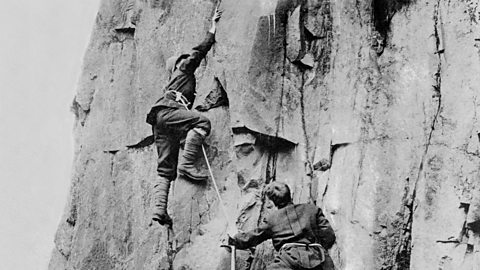
Breaking into trad can be difficult, partly because it is so expensive and scary, and partly because so much experience is required to trad climb safely. It’s like those jobs that you need 50 years of experience doing to even get an interview; somehow you are expected to have experience doing the job that you need in order to get that same job. It’s a little paradoxical (perhaps a lot paradoxical), but in this context, it makes some sense. Knowing how to place gear takes practice, so no one wants to follow your trad lead if you don’t have said practice, but then you will never practice. So, often, more experienced trad climbers will lead everything and the newer trad climbers will follow the leads/clean the gear to at least begin recognizing good placement.
This is the phase of trad climbing I was in (the new follower, that is).
A few weeks ago, my buddy (big trad climber) and I went to Tahquitz so I could get more following practice. If you haven’t heard of it, Tahquitz is a very classic granite peak that OG climbers used to train on for Yosemite. It’s rich in history and in fantastic climbing, though as you can imagine, the grades can be a tad stiff as these routes were put up as the Yosemite Decimal System (YDS) was being established. Anyway, we decided to climb this 4-5 pitch 5.6 called Jensen’s Jaunt. How bad could 5.6 be, right?
The day starts wonderfully, but quickly takes a turn for the worst as this climb is incredibly scary and definitely not 5.6. We have to pull some shenanigans to bypass some features, and already we were second guessing how to proceed.
The situation devolves as the sun beats down on us and the pitches get increasingly more exposed and scary. We finally reach the final pitch about 3 or 4 hours past schedule. The belay is this ledge with a tree as an anchor, which blocks most of your view of the rest of the route. There is quite a deep ledge a couple of moves above, so after those few moves the climber is completely out of sight for the remainder of the climb. At this point, my seasonal allergies have taken a huge toll on me, and this tree was FULL of pollen; each flower on the tree had bees snacking and buzzing along. So, while I am belaying, I can hardly breathe. Meanwhile, my climber is trying to find the rest of the route. After about 20min in one direction, he realizes it is actually the other direction, so he down climbs all the way back to me to change directions. Already defeated, he takes a quick swig of water at the belay spot and presses on.
After a long, long silence, I hear “[High-Clip], I can’t do this.”
I tell him to come back to our anchor.
Once he is back, I can tell we are in bad shape. We have traversed rather far around the mountain, and rappelling would be a gamble as we don’t know if we can make any anchors below us. I very much dislike this option, so I propose that I take the lead. With a lack of better options, my partner agrees. We swap gear and he tells me everything he can to prepare me for the moves and the following gear placements.
And thus begins my first trad lead.
Everything is incredibly easy at first, and I clip the 2 pieces that he left in the wall for me. Then I get to the slab section. There are a couple jugs to start (about 15ft from the last piece of pro), and then it is completely blank, flat slab until a crack forms a few body lengths up. I can coax myself onto the jugs, as there’s really no way I could possibly fall given the angle of the slab and the depth of the jugs. I can even begin the bare slab part, but then I realize the gravity of the situation. Because the slab is completely flat, there is no possible way to place any protection. Additionally, although I can find maybe two tiny pebbles for my right feet, my left foot will have to rely on friction, and while my right hand can try to compress around the slopey arete on the right, my left hand will also need to rely on friction.
Being 20ft up and to the right of my last piece, I was less than thrilled to do this move.
If I fell, I would probably get decently injured.
If I came down, we’d have to do a sketchy rappel into unknown terrain.
I was running out of options.
Breath by breath, I coaxed myself to the crux: standing up on the tiny pebble with no other holds. I could see a pinch that marked the beginning of the crack, and I knew once I hit that, I could place a #1 or #2 and sew up the rest of the route per my instructions. Fear aside, I believed that I could physically do the move. After a number of minutes of internal debate, I decided that that fact was enough for me. We needed to get off this mountain, and it was physically possible for me to make that happen. Therefore, I needed to stop wasting energy by stalling and just do it.
Coaching myself out loud, I did the moves with my breath, and grabbed that pinch like my life depended on it. Locked in, I move my feet up (just smearing now) and take a deep breath of relief. Then I realize that without any feet, I am too short to be able to place anything in the crack securely. My heart races again as regret floods my system. But it is too late to go back now. I don’t really know how to crack climb, but the crack is all I have, so I throw in a fist jam to get high enough for good feet. Somehow it sticks. I see immediately it is too wide for a #1, so I pull out the #2. The sides of the #2 don’t even touch the sides of the crack. Before I can fully panic, I grab a #3 and throw it right in. It fits in the crack like it was made for that exact width. I clip faster than light and exclaim my relief to my partner below, who also relays his relief. It is at this point that the reality of my actions hits me, and I realize that at this point my only pro is something a brand new trad climber (me) placed. So I immediately climb up to find a spot for another piece. I can get a #1 in very, very deep, but I am not convinced my partner could get it out. He immediately tells me not to worry about it, and that I should be safe and place the best that I can, and he’ll deal with the cleaning. And so I stuff that #1 so deep in that crack that it looks like the rock ate it.
I continue my way up, awkwardly shimmying up an off-width section, and I place pieces as often as I can. Much to my surprise, I knew which cam to choose at each point. I even recognized the right size nut to place. I suppose this whole following technique actually works (maybe…). Finally, after climbing nearly the full 60m of my rope, I reach the top, and try my best to make an anchor on the little boulders that are all around. I belay my partner up, and he expresses how proud he is of me and what a great job I did both doing the moves and placing the subsequent gear.
We descend, and eventually make it home 5 hours after schedule.
My allergies did not improve for another 12 hours.
We are unlikely to return for some time, but it is nice to know that all of the effort and work I have put in to staying calm on the wall has paid off to some degree.
Stay safe out there, and know that 5.6 isn’t always 5.6!
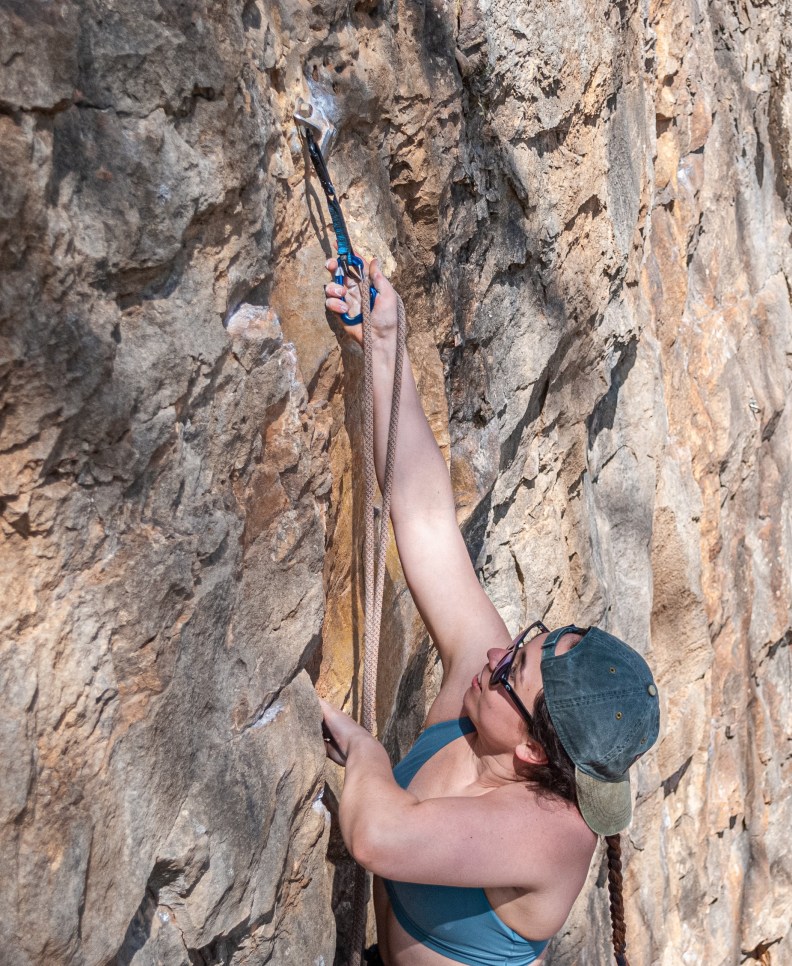

 thedihedral.com
This was an exciting read. I also enjoyed learning some of the climbing lingo. I’m happy it all turned out well and that both of you ended up safe.
LikeLiked by 1 person
Congratulations on such an accomplishment!
LikeLiked by 1 person
Thank you!
LikeLike
I enjoyed reading this post. I can certainly relate to those first-trad-lead feelings. I used to think 5.6 was a moderate, do-able grade until I climbed trad at Joshua Tree. I too learned the hard way that 5.6 is not always 5.6!
LikeLiked by 1 person
I feel that! Especially J-Tree…way to go!
LikeLike