
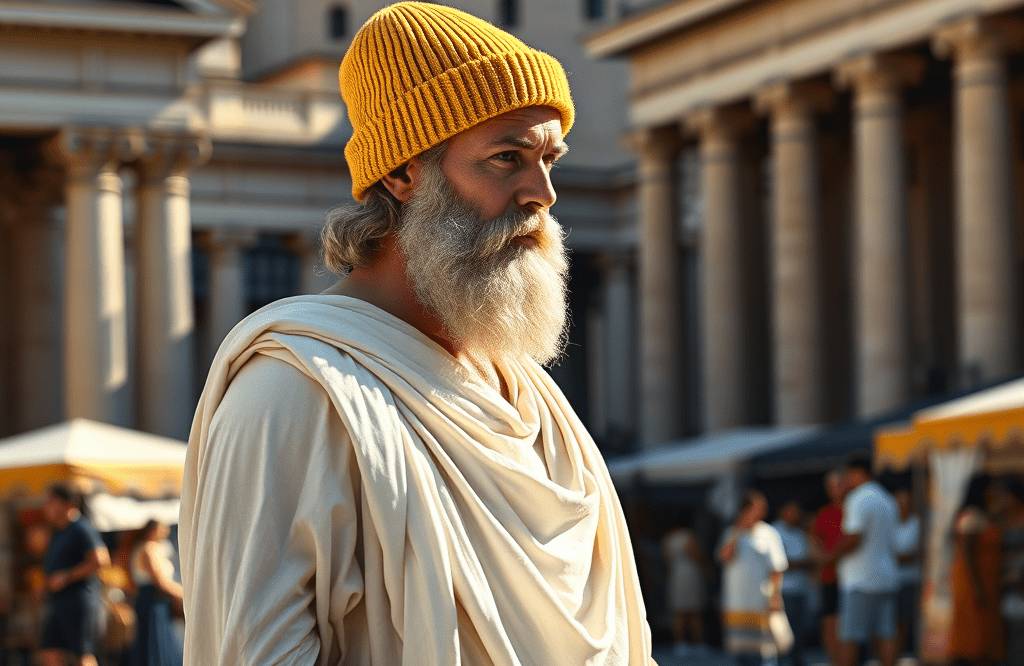
You could argue that Aristotle is the most impactful person to ever have stepped foot on the planet. He was wrong about nearly everything he ever said, but as is often the case in philosophy, greatness doesn’t come from the results, it comes from the process. And the process that Aristotle used has become the way in which we see, understand, and reason about the world. Aristotle didn’t give us the correct answers to questions about the biology, astronomy, the soul, or nearly anything else, but he gave us the means to go about answering those questions, means that we have relied on ever since.
As the “Father of Logic”, Aristotle formalized the process of reasoning that we still depend on today, a process that has seen us through all the great (and not-so-great) thinkers of the past, present, and future. Aristotle was way off about a geocentric model of the universe, but the methods by which he drew that conclusion are what allowed the idea to flourish for centuries.
Among a wide array of thoughtful contributions to the wealth of knowledge within philosophy, Aristotle stipulated that there were four causes for everything that exists. From peaks to pitons, every object consists of a combination of four specific causes.
So, then, when someone asks the question “Why?” we respond by pinpointing one of the following four causes. A response that often begins with “Because”.
- Material Cause = Matter/Stuff/What something is made of.
- Formal Cause = Form/Shape/Definition/What it is.
- Efficient Cause = Creator/Destroyer/Source of change/Why it is.
- Final Cause = End/Goal/Purpose/That for the sake of which.
To understand this a little better, let’s examine a specific object through the lens of these four causes. The Petzl Spirit Express Quickdraw is among the most popular quickdraws on the market. It’s lightweight, durable, ergonomic, and in short has everything one could want from a carabiner, so, let’s examine why!
- Material Cause = Aluminum Carabiner, nylon sling, TPE (thermoplastic elastomer) STRING. Why is the Spirit Express light? Because a thing retains the qualities of its stuff. Aluminum and nylon are light!
- Formal Cause = This Carabiner features the Keylock carabiner system. Why is this a carabiner? Because it’s formed like a carabiner.
- Straight gate design offers an excellent grip and makes clipping and unclipping easier.
- Bent gate design allows you to efficiently clip the rope.
- Flat carabiner spine offers excellent stability when holding it in your hand or pinch clipping.
- The STRING quickdraw sling protector stabilizes the carabiner when clipping.
- The ergonomic shape of the EXPRESS quickdraw sling makes it easier to grab.
- Efficient Cause = Who/What brought this into existence? Why does this quickdraw exist? Because Petzl created and produced it.
- Final Cause = What is the purpose of a quickdraw? Why does this exist? Because climbers need to protect themselves while climbing.
The Final Cause is the most important factor when determining superiority of an object. An increased ability to achieve the final cause makes for a better item. The final cause of a chair, for example, is to provide a place to sit. So, a chair with a nail poking out of the seat would be inferior to a chair without a nail poking out. Similarly, a quickdraw that better protects a climber is a superior quickdraw.
To properly identify the Final Cause, one must find what is peculiar to an object, and once an object achieves its final cause, i.e. once it realizes its peculiarity, it is said to be happy. A quickdraw sitting in a closet may be a quickdraw, but it won’t be happy until it’s achieving its purpose, and so, a happy quickdraw is a quickdraw that is on the wall protecting someone’s life.
While thinking about the Four Causes of a quickdraw is fun (I may have an odd interpretation of fun), it might be more meaningful to consider the Four Causes of a climber.
- Material Cause = Cells (perhaps a little grit)
- Formal Cause = Calloused hands, strong tendons, probably a beanie
- Efficient Cause = The first vertical exposure to rocks/polyurethane
- Final Cause = To Climb
A happy climber then, is one who is climbing.
Applying the same line of reason to a person qua person, Aristotle believed that what is peculiar to us, is that we have the ability to reason in a very unique way. Therefore, the Final Cause for a person, that is, the purpose of human life is to reason. And so, a happy person will be a person who reasons, and a better person will be one who reasons well. Thus the person who takes philosophy seriously will be the best and happiest of all.


 thedihedral.com
I woke up the other day thinking, “What’s fucking point?” After a while, I got an answer that made sense to me. I don’t know how Aristotle would see it, but in this question, I am the carabiner. The answer to the question? I went to China and taught back in the early 80s. Two years ago, out at the Refuge in the back of beyond, in a snow storm and in solitude, a car approached. A guy rolled down his window. “Can you tell me where we can find the Sandhill Cranes?” He had a Chinese accent; a Beijing accent. I greeted him in Mandarin. We talked and he asked how I’d learned Chinese. I told him. He rolled down the back window and there was grandma, smiling. We made eye contact and told each other everything without a word. We’d shared a world that even her son didn’t know. THAT’s the fucking point. Two women — each with her own long climb — summit in the middle of the nowhere, unexpectedly.
But…I’ve been interested in pi for a very long time and after “talking” to an AI about it the point was clear; it’s a freakshow of a number — so irrational as to be transcendental (huy?) but the whole point of it is we can do things with it that we couldn’t do without it AND it’s always the same. I thought, “Wow, function AND inscrutability.” But then i also thought, “It’s the thing itself, whatever it is.” And that, as far as I can tell now, is the carabiner. OK, I’ll go now…
LikeLiked by 1 person
This is why I love your comments Martha! The carabiner, the sandhill cranes, and Pi. Someone trying to connect those dots may struggle, and maybe in that struggle, they become the carabiner too! Thank you for connecting some dots!
LikeLiked by 1 person