
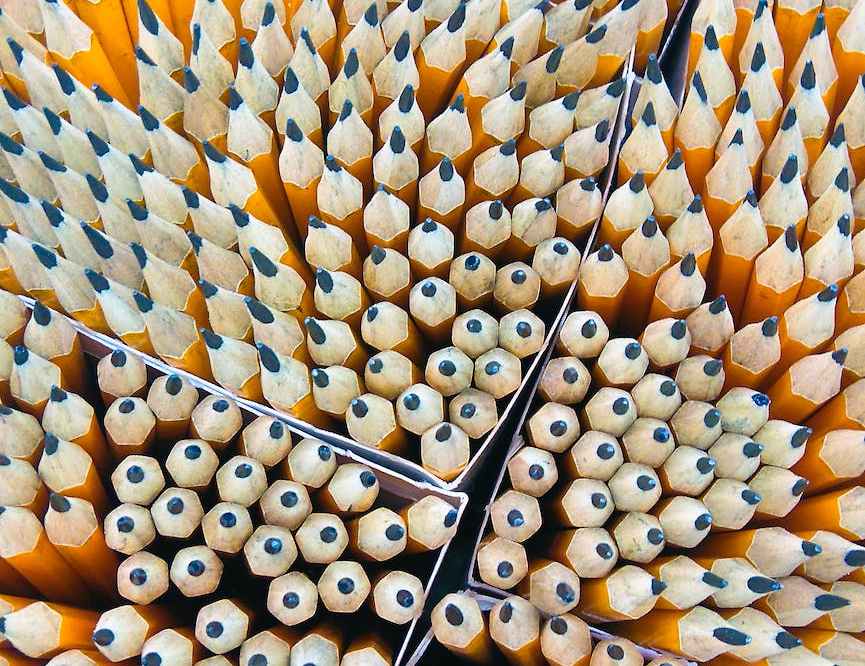
I kind of love pencils. However, I’m a little bougie when it comes to writing. Not over the top, but if given my druthers, I’ll take a mechanical pencil over a typical yellow wood pencil any day of the week. I have no problem with a sharp wood pencil, but once the point dulls, I’m over it. Mechanical pencils are perfect for underlining important text in a book or making notes in the margins. The refillable aspect of mechanical pencils allows them to stay in service for years and years. One of my most cherished objects is an old mechanical Bic pencil that my grandpa let me borrow when I was in grad school. The eraser is taped in place, the once blue pencil grip is frayed and discolored, but it still works like a charm. I have used it to take notes nearly every day since he gave it to me. Essentially, it’s worthless, but to me that pencil is priceless.
A few days ago, I went rock climbing with some friends, once I got home, I grabbed that reliable old Bic to check off some newly completed routes in my guidebook. As I was checking them off, I got to thinking about the history of pencils, and how little I knew about pencils. I did a little digging and found some very interesting facts. Here are five things I just learned about…Pencils!
- Okay, so we all know that pencils don’t actually contain lead, they are made of graphite which is known as a pure carbon form. Interestingly, diamonds are another pure carbon form. The reason graphite and diamonds are so different despite having the same chemical makeup is the way in which the carbon atoms are arranged. Diamonds contain carbon atoms stacked in a pyramid structure making the bonds tight and strong, while graphite contains atoms arranged in sheets made of hexagonal lattice. Those sheets of carbon break apart very easily making graphite the perfect substance for leaving marks.
- There is a little legend, the truth of which is uncertain, about the origin and discovery of graphite. Borrowdale, England, 1564, a shepherd noticed that a tree was felled by a strong wind during a storm. Attached to the tree roots was a shiny black substance, and beneath the tree was a great deposit of the same substance. Graphite! The shepherds noticed how useful the substance was at making marks and started to use it to keep track of their sheep. Graphite, being soft and brittle, required a sheath, or some means by which to keep it firm. The shepherds began to wrap the graphite with wool, and violá, we have pencils! Independent of the truth of the Legend of Borrowdale, it is known to be the spot of the first commercial graphite mine.
- Just one year later Swiss Naturalist Conrad Gessner published a drawing of a stick of graphite encased in hollowed out piece of wood. This invention is said to have spread quickly, by 1662 pencils were being mass produced for the first time in Nuremberg Germany. In the early days of the pencil, folks would use lumps of old bread to erase their mistakes, but by 1770 we had the makings of the modern-day eraser. Chemist Joseph Priestly noticed that a gum harvested from trees in South America was much more useful for erasing pencil marks. And while the gum was better than old wads of bread, it still did require some rubbing, thus Priestly named this gum rubber.
- The graphite pencil was the only pencil option until 1794. France was at war with Brittan, and imports were cut off. This essentially amounted to a graphite embargo, and France was out of stock. Nicholas-Jacques Conté was tasked with finding an alternative, and so he set off to do his best. Conté was a brilliant thinker and at times called upon by Napoléon himself. After attempting different techniques for a new “lead” he tried mixing low quality graphite with clay, which he shaped into rods and baked in order to eliminate the moisture. Succès! Crayons Conté is essentially the same pencil we use today!
- Although Conté is responsible for mixing graphite with clay, it took some time to perfect the ratio. I was shocked to find out who perfected the mix that gave the world the #2 pencil. Charles Dunbar got into the pencil-making business with his brother-in-law John after happening upon a graphite deposit in New Hampshire in 1821. John’s son David an unemployed college graduate started working in the family business and helped to develop new refining methods making pencils less brittle and less greasy. Based on these refining methods new pencils could be offered in a variety of densities. #1 was the softest, and #4 was the hardest, but it was the #2 pencil that hit the mark. The #2 pencil became the Goldilocks standard, and that is why they paint pencils yellow. (That’s not true, they actually started painting pencils yellow to copy a luxury pencil that was announced at the 1889 World’s Fair in Paris.). The new Thoreau Pencil became the standard pencil in America and has remained so ever since. All thanks to John’s unemployed son David also known as Henry David Thoreau!
As Henry David Thoreau once said: “Rather than love, than money, than fame, give me 5 things about 1 topic”.
V5 (5 things 1 topic)

- I kind of bounced around looking at sources on the history of pencils, but most the info came directly from this NPR Skunk Bear video!

 thedihedral.com
OHHenry!!! I love your humorous elements of surprise in your posts!.
LikeLiked by 1 person
Thank you Sunyamar!
LikeLike
Something else we just take for granted, but it’s so interesting to learn about its origins. Thank you for sharing your research with us!
LikeLiked by 1 person
Yes, of course, I’m happy you liked it!
LikeLiked by 1 person
Don’t forget the famous but short-lived Blackfeet Indian Pencil. This was an indigenous-owned company in Montana which produced pencils from 1972-92. They were encased in unpainted cedar, not the ubiquitous bright yellow lacquer. They are still sold (mostly on eBay) as a collector’s or vintage item.
LikeLiked by 2 people
That is the tidbit I was hoping for! I’m all about the cedar pencil!!!
LikeLiked by 1 person
Didn’t Thoreau make a living making pencils?
LikeLiked by 1 person
Until I looked into pencils I had no idea, but he sure did. I bet he had no shortage as he wandered into the woods!
LikeLiked by 1 person
Probably sharpened them with a pen knife.
LikeLiked by 1 person
That is a 10/10 pun! And also probably true!
LikeLiked by 1 person
I didn’t even see the pun… My brain hurts… 😀
LikeLiked by 1 person