

As a person in STEM, I have read many papers, journals, textbooks, etc. While they may actually make sense on occasion, I often find myself wondering if the writers are trying to make their work harder to understand to make themselves seem more intelligent. Today, I’m going to see if this actually works. I’m going to write the most confusing (and fake) paper on how to rock climb, and you will tell me if it makes me seem smarter!
Abstract
Recent works of theDIHEDRAL et al. have attempted to describe the occurrences of a human activity referred to as rock climbing (RC). People who engage in RC often report changes in their physical form, such as increases in muscle size and callous growth. They also report mental changes such as frequent episodes of joy or fear (source 1). Here, we will focus on the act of RC itself, and we will introduce a new tool called “beta” to solve the major discontinuities in RC theory.
Introduction
First, we must define RC. For other terms, refer to theDIHEDRAL et al. RC is the act of transporting oneself up vertical rock, using only rock. The goal of this work is to illuminate how this process is achieved. We will discuss the procedure on the horizontal ground, on the vertical rock wall, and at the void area of the air.
Section I: Ground (Horizontal)
It is a trivial exercise to see how a climber may acquire the necessary gear to participate in RC, so we will assume that all climbers possess the appropriate gear. Next, using the methods in source 2, climbers will have a belay partner. It is obvious how the belay partner will assist in managing rope in the RC system.
The climber must now engage the upper, middle, and lower body muscles in an attempt to generate force against the ground to propel themself upwards. Recalling the force of friction and the normal force from sources 3-4, it can be seen that the climber will exert force on the rock. After this state has been reached, they may begin the next process.
Section II: Wall (Vertical)
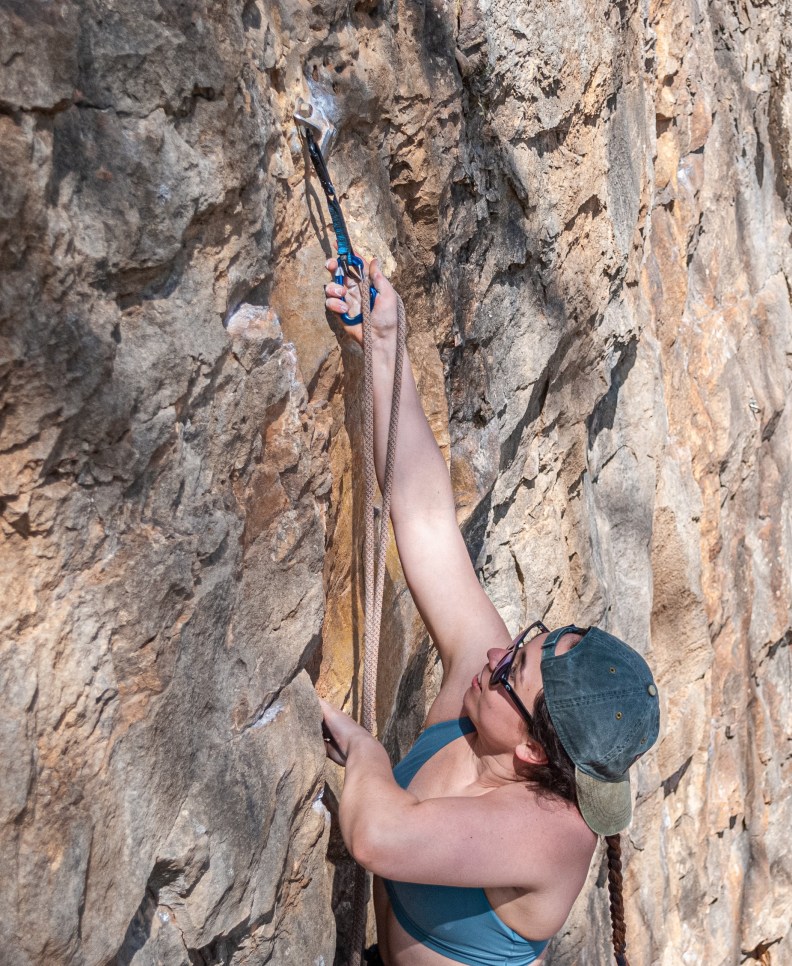
As discussed in the previous section, climbers will need to exert force on the rock wall. Derivations of the relevant equations can be seen in Appendix A. In order to prevent catastrophic failure of survival, the climber must attach themself via a fastener and the rope to the wall (see figure 2.A). This is optimized when done between the face and hips, as the most energy is saved.
We will now introduce beta to the RC theory. Previously, when climbers were unable to foresee their upcoming path, they were given the instruction to “just go up” (source 5). With the new beta term, climbers may predict and prepare for their future use of forces to obtain more verticality.
We will use different moves to define beta; readers unfamiliar with moves should refer to source 6. A belayer or spectator on ground (see section I) may concatenate a sequence of moves (as defined in source 6) in a verbal delivery to the climber. This phenomenon is referred to as “giving beta.” In table 2.B, the effect of beta versus no beta can be witnessed. Future work should further research the optimal length and delivery of beta to assess how climbers will most benefit from it.
Section III: Air (Void)
In the regime of the air, when the climber is neither on the ground nor on the wall, our RC theory begins to break down. The rate of change of velocity due to gravity on Earth compared to the processing speed of the average human brain is too high, and hence our current methods do not effectively predict the phenomena here. However, as seen in sources 7-10, simulations show that while we may not be able to effectively model RC here, we may predict the outcome given certain initial conditions. For example, without a rope or cushioning, entering this regime usually results in injury or death (source 8). With gear as given in source 9, we see that injury is possible, but systems in the human body remain as functional as they were before entering this area.
Conclusion
With the RC theory developed by theDIHEDRAL et al., we have been able to predict and describe RC for humans. Introducing beta, we have seen better results in vertical gain. Recent simulations have given us insight into what happens in the void region, but work remains to be done in correcting these divergences in RC theory.
Appendix A
From equation 3.5.15 in source 4, it is clear how we obtain our final equation here.
Acknowledgments
We thank theDIHEDRAL for their outstanding work on RC theory and their support of furthered research into this field.

 thedihedral.com
This may become one of my favorite papers! My favorite is “Parachute use to prevent death and major trauma when jumping from aircraft: randomized controlled trial”. (And second favorite is the meta-analysis of previous studies that led to this RCT.)
From reading many studies, I have found that a two-part title is important if you want to appear scholarly. Hence, my own paper, “Colonoscopy: an analysis of punctuation in the titles of scholarly articles”.
LikeLiked by 2 people
An important goal at any time of day or night, “…catastrophic failure of survival….”
This totally cracked me up, “In the regime of the air, when the climber is neither on the ground nor on the wall, our RC theory begins to break down.” This can happen in the back yard, too.
I love this. Thank you. I badly needed a laugh.
LikeLiked by 3 people
No, Martha! The goal is “to PREVENT catastrophic failure of survival”! Don’t climb again until you clear that up!
LikeLiked by 2 people
Wow. That explains a LOT!!! Thanks!
LikeLiked by 2 people
Glad to be of service. I’d like to keep you around. Bear and Teddy need you.
LikeLiked by 3 people
See Source 11, Appendix B for my response.
Sources:
11.
B. It’s evident that the diHEDRAL (llc?) team has clearly operationalized their theory with concrete examples, and through experience. Hence the variables might warrant a more longitudinal study in which a cross-sectional study might be helpful. Their clarity and conciseness, coupled with their formal, yet friendly, tone, present a valuable and reasonable conclusion for the RC theory for humans; despite further study needed in regards to divergences .
On a personal note, gravity, most times, prohibits me from exerting force on the rock; therefore, the salty sweat gathered on palms before even attempting to exert force on the rock creates problems in the human system. Prior to the evolution of AI and LONG after the Industrial Revolution, I participated in a study of RC with Ex #3 (see Source 12–section a.b.c.53) I made it to Section II. My outcome was a positive due to belay partner yelling, “just come down, you’re on a rope.”
LikeLiked by 1 person
Excellent and astute analysis!
LikeLike
At last, I understand!
LikeLiked by 1 person
Haha…I think I confused myself with all of this!
LikeLike