
There is a Siren Song harmonizing the implementation of AI in the classroom. Teachers can use AI to create assignments for students. Students can use AI to help with the research process. Students can also use AI to write papers, solve math problems, coordinate sources, and do pretty much any assignment in a matter of minutes. Teachers can use AI to look for signs of cheating. Students can use AI to cover up the use of AI.
I have seen some astute and creative uses of AI in the classroom by both professors and students, and I think that there is room for some integration, but that integration comes with some major risks and the potential to cause major harm.
Personally, I do not use AI or assign the use of AI in any of my classes. Perhaps teaching philosophy grants me that luxury. A luxury that may not be available in other disciplines, such as computer science or other industries in which AI has become the norm.
There is a group of scholastic influencers who have been deemed “the refusers”. This group includes academics who are not willing to shortcut the long arc of progress for shortcuts that may save time but ultimately cause irrevocable harm. Leading voices in this movement include Comp and Rhetoric professors Maggie Fernandes, Megan McIntyre, and Jennifer Sano-Franchini.
More details on their stance can be found on this thought-provoking podcast with Jay Todd.
https://cat.xula.edu/food/conversation-122
Their stance is summarized by the following list they compiled and published.
12 Reasons to Refuse Generative AI: A Writing Studies Perspective
- Language, power, and persuasion are interconnected (Bender et al., 2023). Writing helps us understand ideas, gain access to resources, participate in democracy, and build relationships with others. We need to consider the risks of altering our writing patterns and habits based on the values and demands of Big Tech companies.
- Over-reliance on GenAI to shortcut the writing process is believed to increase cognitive offloading, and may limit your growth as a critical thinker, writer, and communicator (Gerlich, 2025).
- Technologies, including GenAI, are never ideologically neutral, and GenAI products are designed to advance the views and aims of Big Tech corporations (Selfe and Selfe, 1994; Noble, 2018).
- GenAI writing technologies are often inaccurate and unreliable.
- GenAI accelerates and advances linguistic homogenization (Owusu-Ansah, 2023).
- GenAI products reinforce punitive approaches to plagiarism and plagiarism surveillance.
- GenAI products are marketed as the future, but there is little evidence that this is more than hype.
- GenAI relies on labor exploitation (Merchant, 2023).
- GenAI products, like other digital technologies that rely on massive datasets, do significant environmental harm (Edwards, 2020).
- GenAI products rely on an extractive economic model that makes Big Tech investors richer at the expense of writers, students, teachers, content creators, and content moderators.
- The current benefits of GenAI do not justify its significant costs.
- All writers should be able to make informed decisions about their use of GenAI technologies in college writing courses and beyond.
I am particularly persuaded by 1, 2, 5, and 11, but I think that all 12 reasons are worth considering.
After learning about this group of refusers, I started thinking about possible parallels in climbing, and while I don’t think that there is a perfect metaphor, I do believe some similarities can be found.
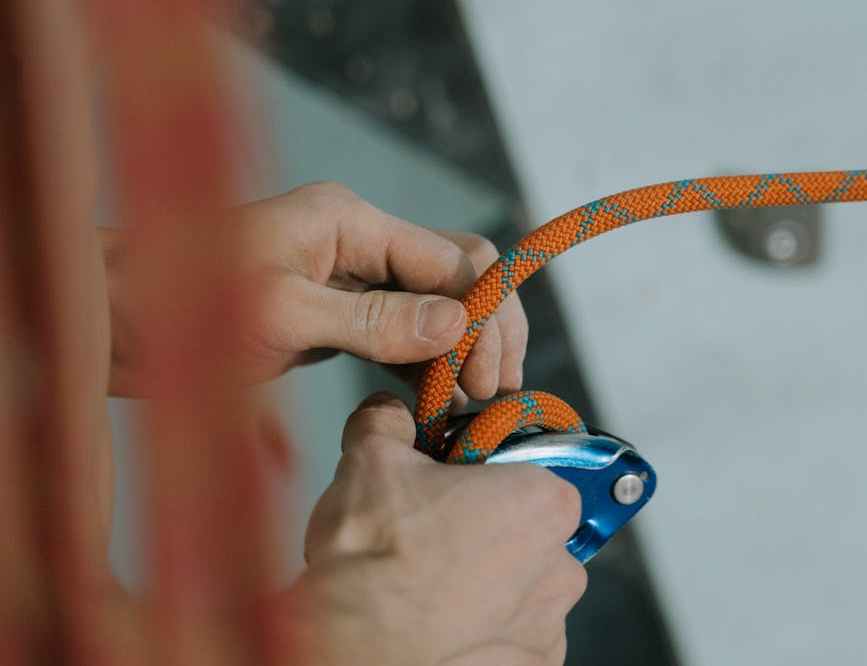
Current protocol in most climbing gyms calls for new climbers to be trained using a self-locking belay device, sometimes called an auto-locker. The most popular being some version of a Gri Gri. Self-locking belay devices are incredibly helpful, they are very intuitive, and they add a level of safety that is missing from alternative belay devices such as an ATC tube style device.
The convenience of an auto-locker lowers the bar for entry in what can be an extremely dangerous activity (Sport Climbing). Nearly anyone can learn how to belay using an auto-locker with an adequate level of safety within the time it takes to heat a frozen pizza.
I am a fan of self-locking belay devices. I use one on a regular basis. However, I learned how to belay on a tube-style device, and what is lost when learning to belay with a self-locker is the attention to detail that must be considered when belaying. Essentially, an auto-locker will catch a falling climber with little to no effort from the belayer. While that function is incredibly helpful, it breeds complacency. New belayers aren’t learning the importance of attentiveness. When a belayer is the sole obstacle between safety and harm, every crux move carries more significance. Attentiveness is a skill that appreciates with experience, a skill that is losing significance the more that we depend solely on self-locking devices.
I am not saying that we shouldn’t use self-locking devices but using them at the expense of learning other important potentially life-saving devices is not a move I would recommend. Of course, we can’t count on climbing gyms to provide that education, gyms function as a business, more customers mean more money. Teaching climbers to use self-locking belay devices is sufficient for their goals, but that doesn’t mean it is a case of best practice, and so it is up to us (the experienced) to provide deeper insights into the importance of diverse skills, attentiveness, and learning. In the end these skills are better for the climber, the community, and the world of climbing.
Similarly, Generative AI may serve a purpose, but without foundational skills, we are trading safety, growth, and community for efficiency. A trade that could very well turn out to be both dangerous and harmful.


 thedihedral.com

Another thing climbing gyms don’t usually teach is how to set an anchor – one that will keep you (the belayer) from flying into space (or a rock) if your climber takes a whipper. I’m old school and we used to practice belaying three 60 pounds sacks of concrete dropped just 15 or so feet. This can be quite instructive for those who skimp on a solid anchor. As for AI, well, its just another tool, not a substitute for thinking (or a good belay). 😉
LikeLiked by 2 people
For sure!!!
LikeLike
At risk of stating the obvious, this is important stuff! Thanks 🙂
LikeLiked by 1 person
That is so nice, thank you Chris!
LikeLike
Paying attention is a skill we can all use more of.
Great to see you back on this page! It has been a while.
LikeLiked by 1 person
It was nice to get some ideas down on “paper”!!!
LikeLiked by 2 people
I’ve missed you, too.
LikeLiked by 1 person
You hit it — it’s HOW we use it. I just spent three days using ChatGPT a LOT. Why? I’ll link a blog post, but basically I wanted to understand what I couldn’t understand in school — high school. What I got from ChatGPT was perfect. I got good tutoring, infinitely patient (people can’t do that easily), and contextual understanding of the larger picture of Math and where my kind of brain might fit in that world.
I still haven’t been able to finish the very simple quadratic equation I set for myself using the standard linear, symbolic, blackboard logic, but I’m closer than I’ve ever been. Standard education (in my day, anyway) failed kids like me who were born different. ChatGPT’s language model training has none of that judgmental attitude a high school math teacher might bring to the classroom. The space is safe. Anyway, here’s the post. I’m deeply grateful for all I’ve learned in the last 3 days. Today I made it all the way to calculus, at least conceptually.
LikeLiked by 1 person
That is such a great way to approach it Martha. I have to admit that I have been reeling from the sheer number of students who are turning in spectacular assignments at the intro level. Just a couple years ago I could barely convince students to cite YouTube or Wiki as a source, but all of a sudden they are citing primary text from Hegel, Kant, Aristotle, and Aquinas. Even more spectacular is that some of these citations are in the original Greek, Latin, and German. All of this to say that I am beside myself grading papers written by a bot.
Some professor are flipping classes so that the instruction takes place outside of class, and the “work” takes place under the watchful eye of the instructor. But I am not there, and don’t plan on heading down that road. Proctoring/policing thought is not my ideal method of teaching.
I’m not sure how I will find balance in this very different era of higher education, but it is nice to be reminded of the positive role that Gen AI can and does play.
LikeLiked by 1 person
I found a lot of value in timed, in-class writing in the pre-AI times. It helped me know the reality of the little demons I mean students. But seriously, they’re citing things in the original Greek? Sorry, but they should know better and plagiarize with more respect for the professor if not for themselves.
My relationship with ChatGPT is positive because I want to learn. That’s hugely different. When it offers to write something for me I get annoyed and I think, “Gimme a break. You’re not a human being. You’re just a synthesis of language skills with the ability to inform. That’s humanesque, but we’re more than that.” It agrees. It panders to me because I’m a good customer, but I’m onto it.
I’ve assigned it projects I gave my upper division bus comm classes a couple of times, and it didn’t succeed simply because it’s incapable of imagining an audience without being told who that audience might be. If I tell it, it does better. Good luck, Carrot. I’m glad to be out of the trenches.
LikeLiked by 1 person
What an interesting analogy, Carrot. I agree that we need to write in order to think, or at least deepen our thinking. Fascinating post!
LikeLiked by 1 person
I’m happy that you liked it, hopefully the point can resonate with some of my students too!
LikeLiked by 1 person
As a writer, I find their first point the most important. Language through the use of word choice is part of our culture through living language. I was already resenting predicative text, before AI was put into seemingly everything. These subtle shifts erase the markings of what makes a writer’s voice unique. After Hurricane Helene last year, I learned what a “holler” was to the people of North Carolina; a narrow valley between two mountains. If the article I was reading at the time had been written by AI with the ability to self-edit instead of a human, the story might have lost the cultural nuance of the man being interviewed. I live in Washington state and grew up in the seventies and eighties often speaking pidgin (a trade language between English and Chinook tribes, aka Chinook Jargon) words learned from my grandparents and great Aunts and Uncles. As they died, I no longer used it because there wasn’t anyone to use it with. I didn’t realize I had lost a cultural gift until it was already gone. One of the few words I remember now is “Skookum” – a great big [something] (cliff, monster, storm). There’s a river called Skookumchuck (great falls or great water) If you travel to climb rock faces all across the United States and beyond, isn’t experiencing the local culture part of the adventure?
LikeLiked by 1 person