
Many of the pre-Socratic philosophers of the ancient world are referred to as Natural Philosophers. These early philosophers asked pseudo-scientific questions such as “what is everything made of?” Answers varied from natural philosopher to natural philosopher, with explanations such as air, fire, numbers, The Aperion, opposites, and The One. By the time Empedocles came on the scene, philosophers had been advancing this question for over one hundred years.
Starting with the father of philosophy Thales of Miletus, who suggested that everything was made of water, a myriad of ancient thinkers took a stab at solving this metaphysical mystery. The initial thought was that everything must be made of one stuff, which can account for both qualitative and quantitative differences in multiple objects. Water, for example, can account for quantitative change through condensation and evaporation. In addition, water can account for qualitative differences as well. Consider the different states of water which include solid, liquid, and gas. Consider further, the desk that you may be working at, perhaps it’s a desk made from wood. That wood started out as a small seed, and then grew into a tree because of water. The same can be said about you, which we now know is composed of nearly 65% water, similarly, over 70% of the earth is covered in water, water both comes from the ground as well as the sky. To suggest that everything is made of water was not a bad first attempt to answer that early question of composition. These one-stuff natural philosophers are referred to as monists. The theories of monist thinkers kept coming to dead ends, and so philosophers began tinkering with the idea that perhaps everything is made of more than one stuff. Enter the pluralists!
Empedocles was one such person. Living from around 490-430 BCE, Empedocles suggested that perhaps everything was made from a combination of stuff that he referred to as elements. Air, Earth, Fire, and Water made up the components on this ancient periodic table, and together they would account for the makeup of all that exists.
A person can be used a great exemplar for how these four elements mix together. Water is the obvious one, as we have already noted. Earth, accounting for solids can be used to explain our bone and sinew. And each time you inhale, the role of air is revealed. This leaves fire, and anyone who has ever suffered through a cold, surely, they have noted the rise in body temperature. Now, anytime one of these elements exceeds/recedes the allotted space, the system is in peril. Too much fire or too little air, for example, could cause destruction to a person. In the end it’s all about balance, homeostasis!
However, by the time Empedocles formulates his hypothesis, philosophers were beyond taking wild stabs at the composition of the universe. By this time, we were more interested in the “why” rather than the “what”.
So then, why do elements come together and fall apart? What causes disruption, imbalance, and a lack of homeostasis?
The simple answer: Love and Hate.
Love brings elements together and hate tears them apart. Love and hate then are the ruling forces of nature.
Empedocles, satisfied that he had solved one of the greatest mysteries facing mankind, a mystery that dated back over a century, decided it was time to go for a climb!
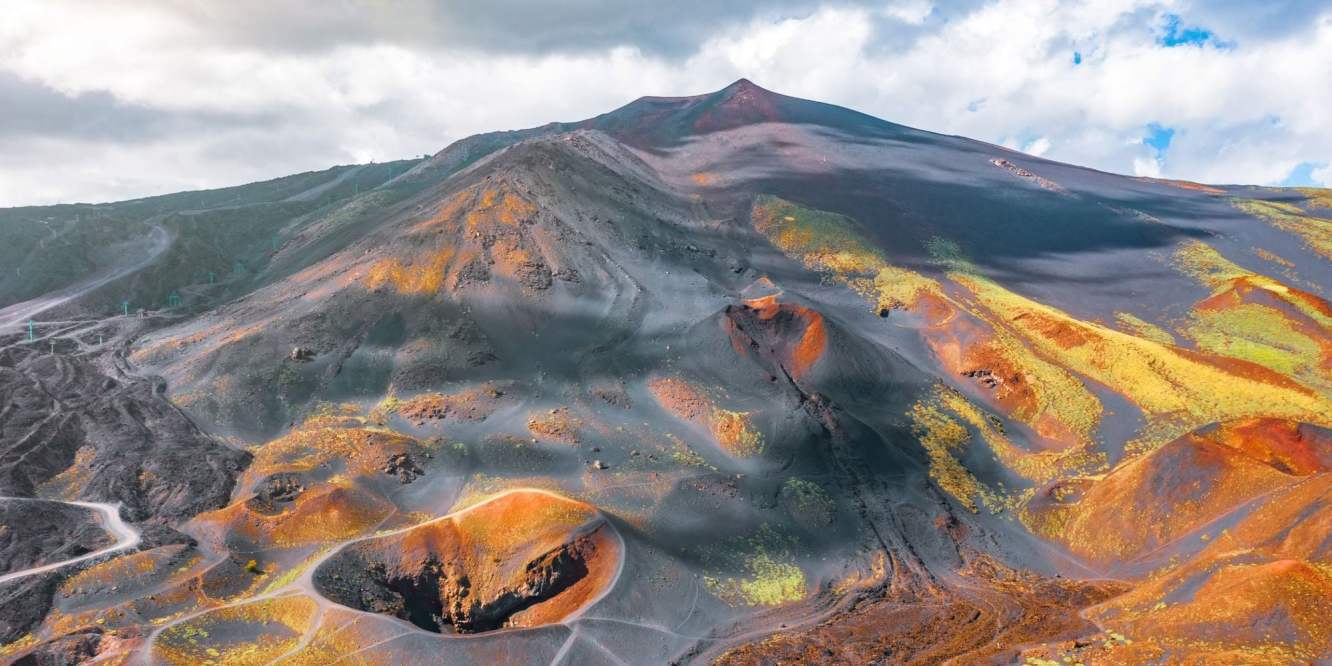
Mt. Etna.
Today, tourists can take a cable car 9,000 feet up Sicily’s tallest and most active volcano. From there they can hop in a 4×4 van to ascend up a couple hundred more feet, before following a volcanologist guide to the top of this 10,900-foot monstrosity. The hiking trail to the summit is considered strenuous and takes between 1.5-2.5 hours to complete.
Lonely Planet recommends long pants, sturdy closed shoes/hiking boots, a wind breaker, warm headgear, gloves, sunscreen, sunglasses to protect against dust and glare, a scarf, trekking poles, lots of drinking water, and perhaps a helmet.
Guides are required for any summit hikes. In addition to expertise regarding the safest path, they can provide any needed gear, and useful information along the trail. With stunning views and plumes of volcanic smoke, Mt. Etna both draws and repels visitors throughout the year.
Around 490 BCE, before volcanology was a thing, before, windbreakers, pants, sunglasses, sunscreen, cable cars, 4×4’s, helmets, hiking boots, and trail guides, Empedocles climbed straight up to the summit. A trek that would make any climber/outdoor enthusiast proud. Wearing nothing but his chiton and sandals, holding the belief that he had finally solved the greatest mystery that humankind has ever known, Empedocles reached the summit!
He drank in the view, nodded as if to say “you are welcome world” and he dove in.
Such was the end of Empedocles life, but the philosopher, the climber, the man who believed that all things were ruled by love and hate quite literally went out on top.

 thedihedral.com
Was Cody Jarrett (played by James Cagney in “White Heat”) quoting Empedocles with his final line? “Made it, Ma! Top of the world!”
LikeLiked by 2 people
Haha, I’m pretty sure it’s a direct quote.
LikeLiked by 2 people
I’ve learned so much new stuff in the last 15 months, I don’t feel like the same person. One of the coolest things I’ve learned is about numbers and functions, specifically asymptotes. These little guys’ describe curves that approach — but never reach — a line. They get infinitely closer, but never reach it. When I looked at the first one offered me I thought my head would explode. I hope I’ve described this right. I’ll never be a mathematician, but if you just think about humanity’s conjectures about reality or even the way we live? We never get there, just, maybe, a little closer, except, I guess Empedolces who jumped in…
LikeLiked by 1 person
That is so useful as a metaphor, I love it. I think I am going to use it when I cover the topic of falsification from the philosopher Karl Popper, who put forth the notion that our “true” theories will one day be falsified…asymptotes! Thank you Martha!
LikeLiked by 1 person
Thanks so much for this information!
LikeLiked by 1 person